


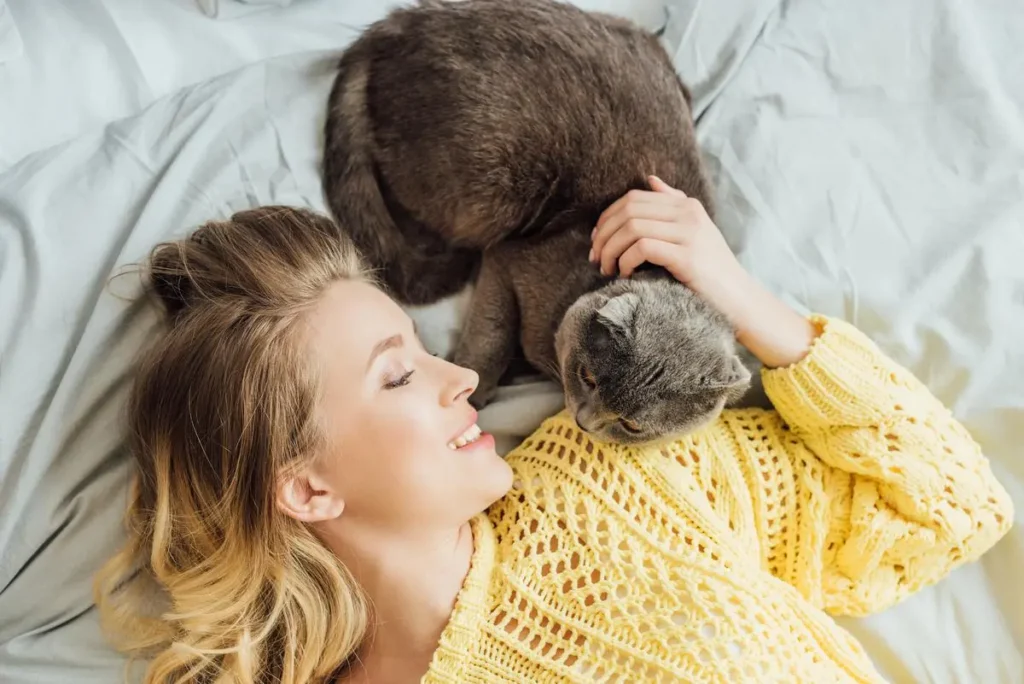
RESEARCHERS EXAMINED THE BOND BETWEEN HUMANS AND DOMESTIC CATS
Happiness between cats and their owners is linked at the chemical level, according to research.
For a month, scientists studied the relationship between people and domestic cats.
A cat’s well-being may be linked to its owner’s emotional state, according to a new study that found a link between bonding hormones in humans and animals, The Independent reports .In a study published in the journal iScience , scientists spent a month studying the bond between humans and domestic cats. They discovered a positive hormonal connection linked to oxytocin, the so-called “love hormone,” which is associated with social attachment, happiness, and affection.
The findings provide the first objective confirmation of a shared physiological bond between cats and their owners. They also challenge the long-held belief that domestic cats are more emotionally distant than dogs.
“Cats are not just passive companions, but active social partners capable of engaging in emotional interactions with people,” said lead author of the study, Dr. Saho Takagi, an animal behaviorist at Kyoto University.The physiological connection between humans and dogs has been well studied. In particular, interactions between dogs and their owners are often associated with similar levels of stress hormones. Meanwhile, the hormonal mechanisms underlying interactions between humans and cats remain largely unexplored.
To measure these hidden biological connections, researchers from Kyoto University and Azabu University observed 19 owners and 29 pet cats for a month. They analyzed levels of oxytocin and cortisol—the main stress hormone—in the participants’ urine, as well as daily interactions between people and animals.
In the study, scientists confirmed that higher oxytocin levels in cats are directly related to higher levels of this hormone in their owners. This demonstrates a clear link between increased oxytocin levels in animals and less severe negative emotional states in humans.When cats’ oxytocin levels increased, indicating they were affectionate and socially engaged, owners reported significantly lower levels of anxiety, depression, tension, and general mood disturbances.
At the same time, higher levels of stress in owners were associated with lower oxytocin levels in their pets. In humans with elevated cortisol levels, cats produced less oxytocin. This suggests that human stress can directly suppress the production of the bonding hormone in animals.
The amount of time owners spent with their cats was also linked to their well-being. Using Bluetooth trackers on cat collars, researchers found that more time spent with their pets was associated with higher energy levels and vitality in owners. However, the length of time the cat had been with the owner had no effect on these indicators.
“Time spent in close physical proximity to a cat, likely reflecting the frequency of petting, play, or other direct interactions, may be associated with more immediate positive emotional states,” Dr. Takagi explained.To determine whether hormone levels influence the animals’ actual behavior, the researchers conducted additional tests. They found that cats with higher oxytocin levels were significantly more likely to approach both their owners and strangers. Meanwhile, cats with higher stress levels were less willing to approach strangers.